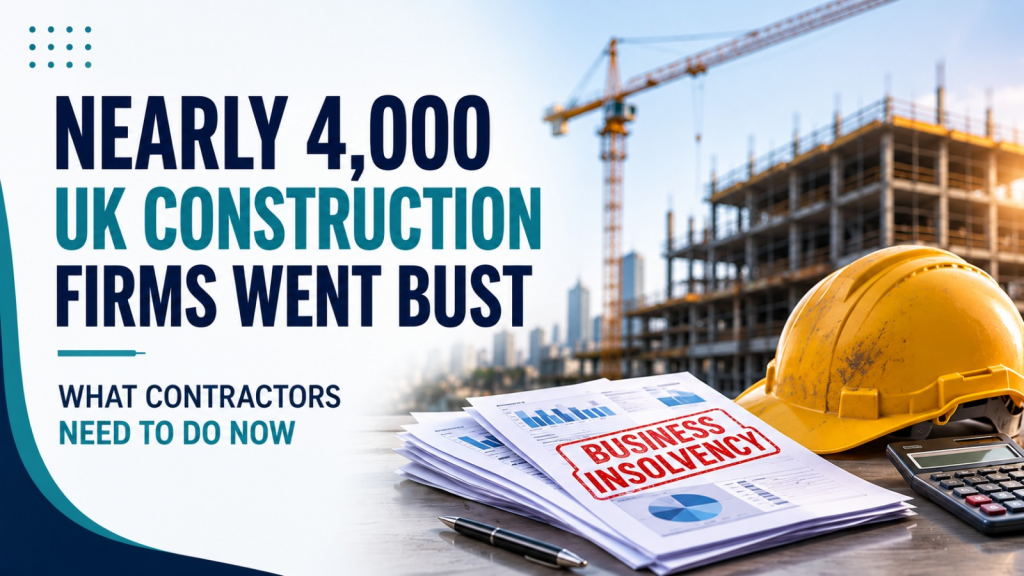
UK construction firm insolvencies are at their highest level in years. Nearly 4,000 construction firms became insolvent in the year to February 2026.Read more about the “Let’s Get Britain Building – NOW!” campaign and why construction leaders are calling for urgent government action. If you run a construction business, this is a warning sign that deserves your attention. Construction is now the hardest-hit sector in the UK for business failures. Almost 4,000 firms went insolvent in the year to February 2026 — more than any other industry, including retail and hospitality, which usually top these lists. If you run a construction business, this isn’t really a story about someone else’s bad luck. It’s a warning sign that the same pressure is probably sitting somewhere in your own numbers, even if you haven’t clocked it yet.
Builders’ merchants Stark and Jewson have gone as far as launching a national campaign, “Let’s Get Britain Building – NOW!”, pushing the government for emergency action. That’s worth noting in itself. These are the companies that supply materials to nearly every builder in the country, and they don’t tend to lobby Parliament unless something has genuinely gone wrong.
Why UK Construction Firm Insolvencies Are Rising
The scale of this is hard to ignore once you look at it properly. Small and medium-sized housebuilders have dropped from around 12,000 in the late 1980s to fewer than 2,000 today. That’s not a slow fade — it’s close to the collapse of an entire tier of the industry.
On top of that, there’s a skills shortage that isn’t getting any better. Tens of thousands of vacancies sit unfilled right now, and the sector is short well over 200,000 workers it’ll need by 2027. Meanwhile the housing shortfall runs into the millions. So you’ve got rising material and labour costs, fewer hands to do the work, and demand that’s high on paper but doesn’t always translate into jobs that are actually worth taking on.
And it’s not just companies going under. We’re hearing about painters, decorators, electricians — solid tradespeople — taking on second jobs just to cover their own bills while work dries up or clients pay late.
Why UK Construction Firm Insolvencies Matter
Insolvency in this sector rarely happens overnight. It’s usually the result of months of thin cash flow, slow-paying clients, and rising costs that got absorbed quietly instead of passed on. A site can look busy and the business behind it can still be in real trouble.
The firms going bust aren’t always the smallest or least experienced ones either. Quite often they’re perfectly competent trades businesses that ran out of cash buffer at the wrong moment — a late payment here, a bounced supplier invoice there, and suddenly the gap is bigger than they can close.
How to Protect Your Construction Business
Start with a proper cash flow forecast, not last year’s accounts. Look three to six months ahead and be honest with yourself about what’s really coming in versus going out, including materials, subs and your own drawings.
Go back through your pricing on live and upcoming jobs. Material costs are up sharply since 2020, so a margin that looked fine eighteen months ago might not hold up now. If a tender hasn’t been repriced recently, don’t sign it as-is.
Get firmer on payment terms than feels comfortable. Late payment is one of the main things pushing construction firms under, and being too polite about chasing it tends to cost you money in the end.
Build in a genuine cash reserve, separate from your working capital, even a modest one. That buffer is often the only thing standing between a late payment and a missed VAT bill.
And talk to your accountant before the problem shows up in your bank balance — not after. Once cash flow visibly looks bad, your options for fixing it have usually already narrowed.
A Real Construction Business Example
We had a groundworks subcontractor client, turnover just under £2 million, come to us last year after two main contractors both delayed payment on the same project by close to ten weeks. On paper, the business was profitable. In reality, wages and material accounts were being kept going on a shrinking overdraft. We restructured their payment terms, put together a rolling thirteen-week cash flow forecast, and renegotiated terms with their key suppliers. A year later, they’ve absorbed two further late payments without it denting operations, simply because the forecasting and the buffer are part of how they run the business now, rather than something bolted on after the fact.
Talk to us before it Turns Into a Crisis
At Magnum Accountancy, construction is where we specialise, so we see these pressures land on a fairly regular basis. If you’d like a straightforward look at your cash flow, pricing or exposure to late payment, book a free call with us. It costs nothing, and it might save you a lot more than that.