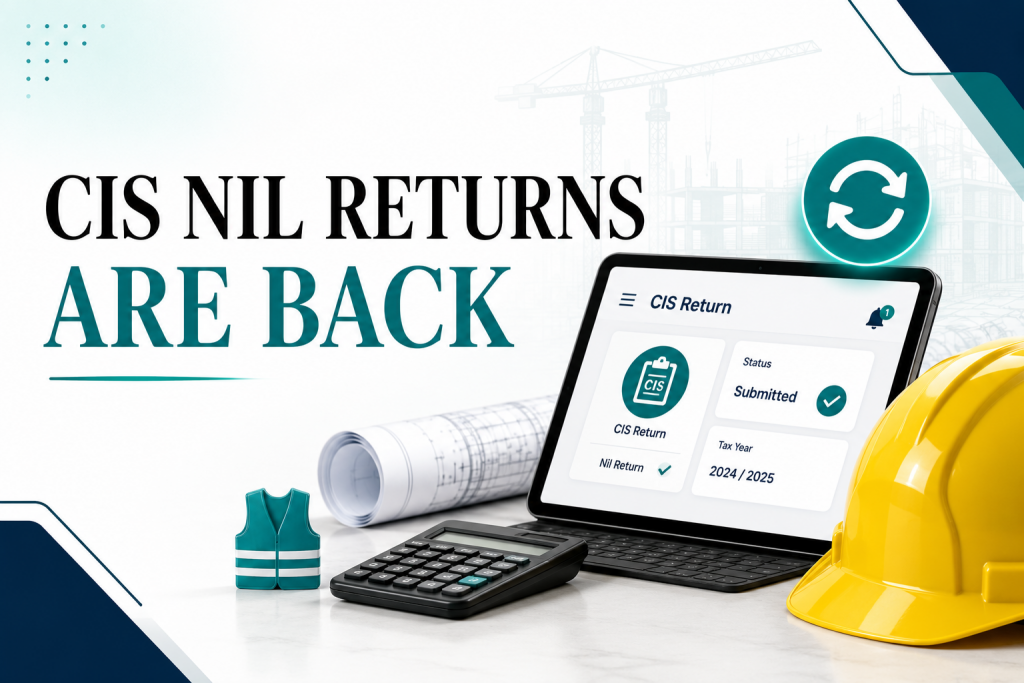
CIS Nil Returns are back, and construction businesses need to understand the new HMRC penalty rules. If you occasionally stop paying subcontractors, failing to submit a Nil Return could now lead to unnecessary penalties. Here’s what has changed and what you need to do.
HMRC has brought back CIS Nil Returns, meaning contractors must now file a return every month, even if they haven’t paid a single subcontractor. Even if you don’t pay any subcontractors, you still need to file a CIS Nil Return or submit an inactivity request. This used to be a requirement years ago, got dropped in 2015 to ease the paperwork, and has now been reinstated with the penalties switched fully back on.
If your business slows down between jobs, or you tend to wind things down over winter, this one’s worth flagging to whoever handles your books. A quiet site doesn’t mean a quiet filing obligation anymore.
What Has Changed for CIS Nil Returns?
Up until now, no payments in a month meant no filing needed, full stop. HMRC has now closed that gap. From 6 April 2026, every CIS contractor needs to do one of two things each month: file a return, nil or otherwise, or tell HMRC ahead of time that no subcontractor payments are coming.
That advance notice is sometimes called an inactivity request, and it can cover you for up to six months at a stretch. Useful if you can see a gap coming, say between Christmas and a new contract starting. The catch is timing: it has to go in before the quiet month starts, not after. Once the month’s gone by without a filing, there’s no going back and covering it retrospectively. For more information, read HMRC’s official guidance on the recent CIS changes.
CIS Nil Returns Deadlines and Penalties
CIS returns are due within 14 days of the end of each tax month, so in practice that’s the 19th. Miss it, and HMRC’s system fires off a £100 fixed penalty automatically, nil return or not.
Still outstanding two months later? Add another £200. Six months late, and it’s a further £300, or 5% of whatever liability should have been on the return, whichever’s bigger. Twelve months late brings yet another penalty, with the size depending on why it was late and whether HMRC reckons it was deliberate.
None of this goes through a person checking whether you genuinely had nothing to report. It’s automated. The system doesn’t know your site went quiet for a month, it just knows a return never turned up.
How Missing a CIS Nil Return Can Cost You £300
Take a small groundworks outfit that keeps subcontractors busy most of the year but hits one quiet patch in February, waiting on a new contract to start. No payments go out, so nobody thinks to file anything. February slips by, then March, and it’s only at the year-end review that the accountant spots two penalty notices sitting there, £300 in total, for a month where there was literally nothing owed. Nobody did anything wrong on paper. They just didn’t know the rule had changed. That’s exactly the kind of gap this reform is designed to catch, and it’s an easy one to fall into if nobody’s watching for it.
How to Stay Compliant with CIS Nil Returns
Get CIS Nil Returns into your monthly routine, not just for the months you’re paying subcontractor.If you can see a quiet spell coming, get the inactivity request in a couple of weeks ahead of time rather than waiting to see what happens.
Not sure whether a nil return went in for a slow month? Check your HMRC online account directly, don’t just assume your software sorted it. And if a penalty notice has already landed, don’t sit on it. HMRC will sometimes accept a reasonable excuse, but only if you get in touch promptly.
For most contractors, the easiest fix is simply not having to think about it: hand the monthly filing to someone who treats it as routine, so a quiet month on site never turns into a penalty in the post.
Talk to Magnum Accountancy
Construction is all we do, so CIS Nil Returns, CIS compliance and monthly contractor filings are part of our day-to-day. If you’d like us to take monthly CIS filing off your hands, or just want someone to sense-check what you’re doing now, book a free call with us and we’ll walk you through it.