- Who Should Track Engineering Business KPIs
- Engineering Business KPI: Quote-to-Win Ratio
- Engineering Business KPI: Job Costing Accuracy
- Engineering Business KPI: Work-in-Progress Value
- Engineering Business KPI: Overhead Recovery Rate
- Engineering Business KPI: Debtor Days
- Why Engineering Business KPIs Matter
- Track Engineering Business KPIs Before Year End
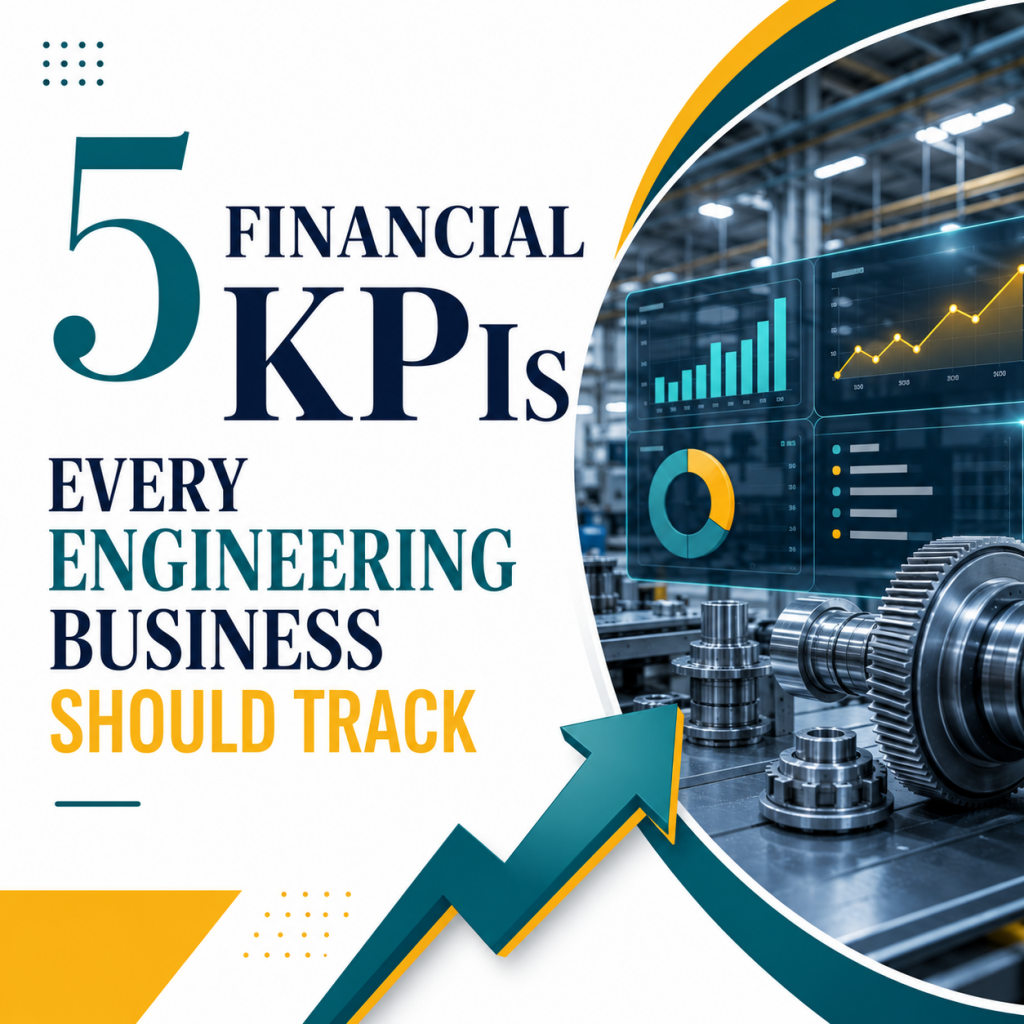
Engineering business KPIs help you understand whether your projects are making money before year end. Most engineering business owners know their turnover and annual profit, but the right KPIs reveal problems while there’s still time to fix them. Gross margin and net profit are fine as a scoreboard, but they tell you the result long after the game’s finished. For project-based work, that’s often too late to matter.
Who Should Track Engineering Business KPIs
This is aimed at engineering businesses running project or job-based work, whether that’s contract manufacturing, mechanical or electrical engineering, or specialist fabrication. If most of your revenue comes from quoted jobs rather than predictable repeat sales, these numbers matter more than the standard set most accountants default to.
Engineering Business KPI: Quote-to-Win Ratio
This measures how many quotes actually turn into won jobs. It has a direct bearing on pricing. A very high win rate can mean you’re underpricing and leaving margin on the table. A very low one means you’re spending time quoting work you were never likely to land. Tracking this by client type or job size often shows where your pricing is genuinely competitive.
Engineering Business KPI: Job Costing Accuracy
This compares what a job actually cost against what you quoted. Most firms quote materials reasonably well, since those costs are visible. Labour and overhead are where estimates tend to drift, particularly on jobs that hit complications. Tracking the gap between quoted and actual cost, job by job, shows where estimating needs tightening, rather than just accepting overruns and hoping the average works out.
Engineering Business KPI: Work-in-Progress Value
This is the value of work completed but not yet invoiced, real value sitting outside your bank account, and easy to lose track of on longer projects. A business can look healthy on paper while genuinely struggling for cash, simply because a large chunk of completed work hasn’t been billed. A current WIP figure gives an honest picture of where you actually stand.
Engineering Business KPI: Overhead Recovery Rate
This checks whether job pricing is actually covering fixed costs, workshop rent, equipment, insurance, admin, not just materials and labour. It’s easy to overlook, because jobs can look profitable individually while the business as a whole isn’t covering its overheads. A recovery rate consistently below target usually means the pricing model needs revisiting, not that you simply need more work.
Engineering Business KPI: Debtor Days
This measures how long it takes to get paid once a job’s invoiced. Engineering businesses often extend generous payment terms to keep clients happy, but slow payers can quietly starve a business of cash even while it looks profitable on paper. Tracking this by client makes it easier to spot which relationships cost more in cashflow than they’re worth.
Why Engineering Business KPIs Matter
Take a mechanical engineering firm that looked solidly profitable at year end, turnover up, margin steady. A closer look at job-level data told a different story. Two large clients were regularly paying over 60 days late, work-in-progress had crept up for months unnoticed, and one job type was consistently running 15% over its quoted labour cost. None of this showed up in the annual accounts. It only became visible once someone looked job by job, rather than at the business as a whole.
Track Engineering Business KPIs Before Year End
Waiting for annual accounts to reveal a problem means the problem’s already happened. Tracking these five numbers regularly gives you the chance to catch it while there’s still time to act.
If you’d like help setting up KPI tracking that fits how your engineering business runs, Magnum Accountancy offers a free call to talk through where to start. Book yours today.