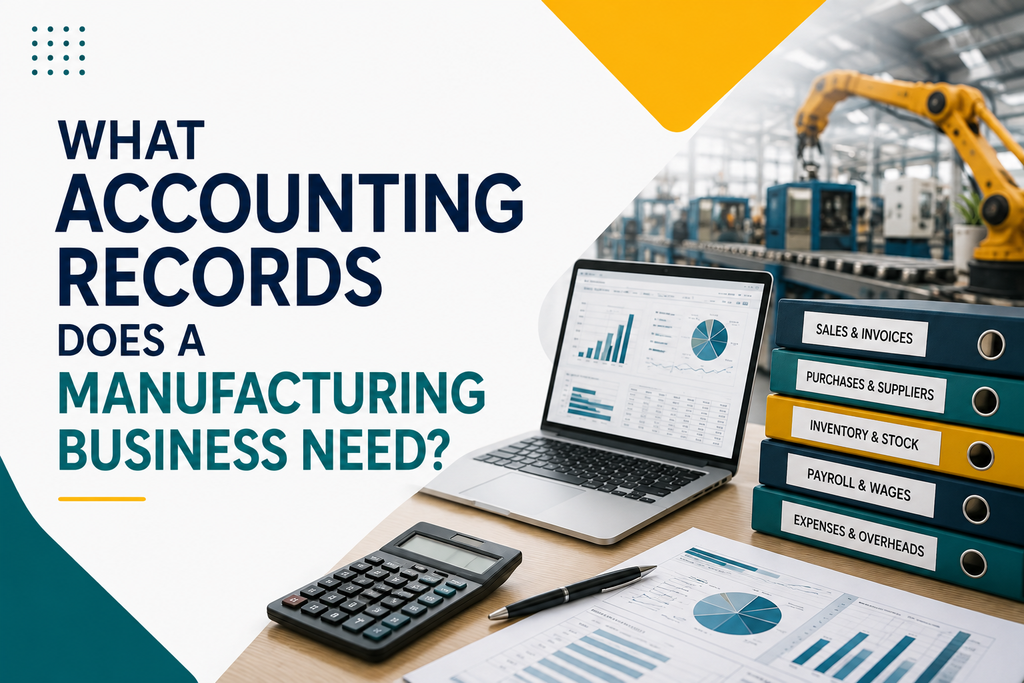
Manufacturing accounting records need to cover more than just sales and expenses. Manufacturers also need clear records for raw materials, stock, work in progress and production costs. Getting this right isn’t just about ticking a compliance box; it helps you see how the business is actually performing.
What Manufacturing Accounting Records Should a Business Keep?
At a high level, most manufacturers need records covering a few different things: money coming in and going out, the stock and work in progress sitting on the shop floor, how the business is performing month to month, and whatever HMRC expects you to hold onto for tax purposes.
What that looks like in practice varies with the size and complexity of the business — a small workshop and a larger production operation won’t run the same systems. But the categories below tend to come up for most manufacturers in some form.
Stock and Inventory Records
Stock is often one of the biggest assets — and one of the biggest costs — a manufacturing business carries, so getting the records right here matters more than in most industries.
That usually means keeping track of things like:
- Raw materials and components you’re holding
- Finished goods ready to sell
- Stock movements, in and out
- Stock valuation, since this feeds straight into your profit figures
Without decent stock records, it’s genuinely hard to know what you’ve actually got, what it’s worth, or whether stock is quietly going missing or sitting unused. Get the stock figures wrong and your reported profit can end up wrong too, since stock values directly affect the cost of sales in your accounts.
Work InProgress (WIP)
WIP just means goods that are partway through production — no longer raw materials, but not yet finished products ready to go out the door. For manufacturers, this can represent a genuinely large chunk of value sitting there at any given moment.
Tracking it matters because it affects how accurately your accounts reflect the real position of the business. Get WIP recording wrong and your accounts can end up understating or overstating both stock value and profit, depending on how the costs are being captured. Depending on the business, this might mean tracking materials used, labour applied, and overheads allocated to jobs still in progress.
Management Accounts and Reporting
Beyond what’s needed for compliance, most manufacturing businesses get real value from regular management accounts — essentially a more frequent, business-focused look at the numbers than annual accounts alone can give you.
Done well, management accounts help you keep an eye on:
- Revenue, and how it’s tracking against what you expected
- Costs — materials, labour, overheads
- Profitability, overall and by product line or job where that’s relevant
- Cash flow, which can get tight in manufacturing given how much money often sits tied up in stock and WIP
- General business performance, so problems get spotted before they turn into serious ones
This is really where the difference between “records for HMRC” and “records for running the business” shows up. Both matter, but management accounts exist to help you make better decisions day to day, not just to satisfy a filing requirement.
HMRC Requirements and a Practical Checklist
Separately from running the business day to day, HMRC generally expects records that support your tax returns and VAT position (where applicable), kept for a certain period of time. Exactly what’s required, and for how long, can depend on your business structure and circumstances, so it’s worth checking what applies to you rather than assuming it’s the same for everyone.
As a general starting point, most manufacturing businesses will want to hold onto:
- Sales and purchase records
- Stock and inventory records
- WIP records
- Payroll records, where you employ staff
- Expense records
- Bank record
- Invoices and receipts
- VAT records, where applicable
- Management accounts and other internal reporting
Think of this as a general guide rather than a fixed requirement for every business — what you actually need depends on how your business operates.
Keeping all of this organised isn’t always easy alongside running day-to-day production, which is exactly where working with an accountant who understands manufacturing, like the team at Magnum Accountancy, tends to help — both with staying compliant and with actually making sense of what the numbers are telling you.
If you’re not sure whether your current record-keeping covers what your business needs, it’s worth getting that properly checked.
Book a free 30-minute call with Daxa at Magnum Accountancy. BOOK A FREE CALL